Many businesses make an expensive mistake: they treat every performance problem as a training problem. Before you put time, energy and dollars into training, find out where the shortfall starts and what is stopping employees from performing well. Here are the key ideas to understand first.
What a Training Needs Analysis Does
A Training Needs Analysis (TNA) compares the performance you expect with the performance you are getting. It helps answer four questions:
- What is the performance problem?
- Why is it happening?
- Is training the right solution?
- What resources or changes are needed?
Where Are the Gaps in Your Employees’ KSAs?
KSA stands for:
- Knowledge: Does the employee know what to do?
- Skills: Does the employee know how to do it?
- Abilities: Does the employee have the capacity to do the task?
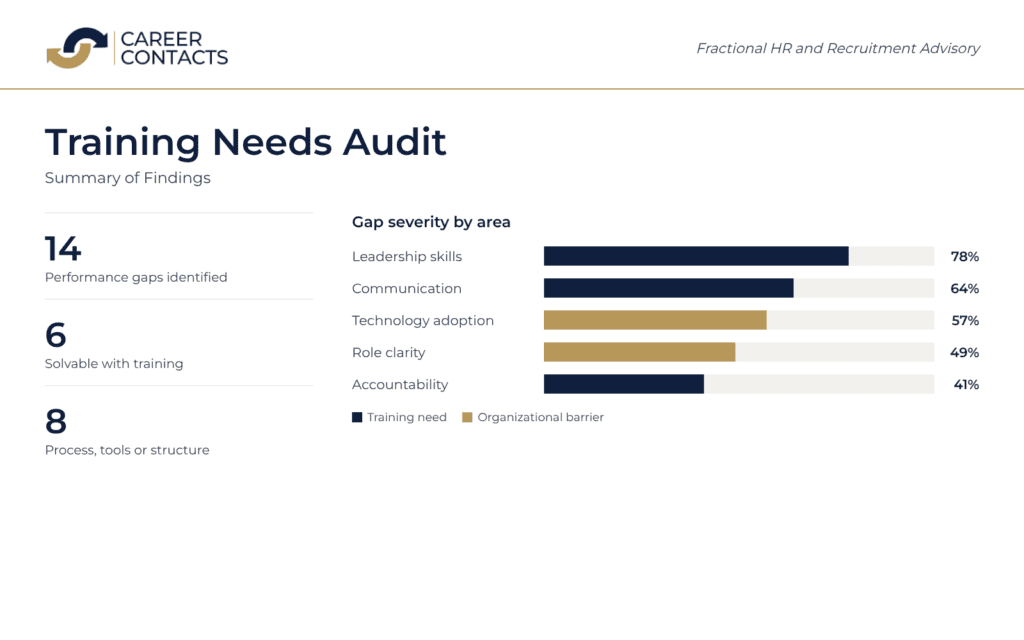
If an employee is missing knowledge or skills, training may be the right fix. Consider this example. A company rolls out new technology. Employees struggle with the software, mistakes increase and productivity drops. The first instinct is to book training on the new system. But what if the software is unreliable? What if only a few people can get access to the equipment? More training will not solve either problem.
When the Barrier Sits Outside the Employee
Sometimes the employee is capable, but something in the workplace gets in the way. Common barriers include:
- Outdated technology
- Insufficient staffing
- Unclear expectations
- Poor communication
- Inadequate resources
- Ineffective management processes
- Incentives that reward the wrong behaviours
This is where leaders need to focus and ask themselves:
- What performance issue are we trying to solve?
- What should employees be doing differently?
- Do employees have the knowledge and skills they need?
- Are there environmental or organizational barriers?
- What solution will produce the best results?
When leaders focus on these questions, they can cut training costs, improve productivity, reassign resources and get better performance.
Best Practices for a Training Needs Audit
A good audit is structured, evidence-based and connected to where the business is going. Here is what we recommend:
- Start with the business goal. Define the outcome you need, such as fewer errors, faster onboarding or stronger leadership bench strength, before you look at people.
- Use more than one source of data. Combine performance metrics, manager input, employee surveys, one-on-one interviews and direct observation. A single source rarely tells the full story.
- Talk to every level. Frontline staff often see barriers that leadership cannot see from where they sit.
- Sort the gaps. Separate skill and knowledge gaps from process, tools, staffing and management issues. Each one needs a different fix.
- Prioritize by impact. Not every gap is worth closing right away. Rank them by risk, cost and how much they affect your goals.
- Set a baseline. Record where performance stands today so you can measure what changes later.
Best Practices for Training That Works
Finding the gaps is only half the work. The next step is to build programs that close them. The most effective training:
- Meets people where they are. An initial assessment sorts learners by current knowledge, so experienced staff are not sitting through the basics and newer staff are not left behind.
- Is built for your organization. Customized content that uses your language, your scenarios and your values sticks better than generic modules.
- Looks ahead. Programs should build the skills your business will need in two or three years, not only the ones missing today.
- Builds in practice. People learn by doing. Role plays, real case studies and on-the-job application turn knowledge into habit.
- Involves managers. When managers reinforce learning after the session, behaviour change lasts. Without them, it fades.
- Is spread over time. Shorter sessions over several weeks or months beat a single full-day event.
- Is measured. Track completion, application on the job and business results, then refine the program based on what you learn.

Diagnose First, Then Build What Matters
It is time to stop guessing and start diagnosing. Ask yourself whether your organization is fixing the cause of poor performance or only treating the symptoms. Then dig deeper.
Knowing that training needs exist is a starting point. The real value comes from programs that meet your teams where they are and move the business in the direction it is headed.
That is where we come in.
Career Contacts runs the audit. Our Fractional HR Advisory team brings 31 years of experience across Canada and the US to find out what is really holding performance back. We look at your people, processes, tools and structure, and give you a clear picture of which gaps training can close and which need a different solution.
Training Arch, our learning and development sister company, builds the programs. Every program is customized to your organization, from targeted workshops to six-month leadership certificate programs, so your investment goes into training that will make a difference.
Together, we take you from diagnosis to development, with no guesswork in between.
Ready to find out what your team needs? Book a talent strategy call with our team, or email us at hr@careercontacts.ca. To explore training programs, visit trainingarch.com.
Authored by Rachel Virani
References
Kilgour, L., Kilgour, E., Rutherford, M., Burton, S. C., & Shelton, N. J. (2023). Administrative Procedures for the Canadian Office (Canadian ed., 11th ed., Ch. 8). Pearson Education Canada.
Blanchard, P. N., Thacker, J. W., & Cosby, D. M. (2023). Effective training: Systems, strategies, and practices (7th ed.). Sage. sagepub.com
